How Thanksgiving got to be Thanksgiving
Nobody planned this holiday. It was put together over 250 years by people who mostly never met. This is the story in order, with a map for each part.
In kindergarten we were taught that Thanksgiving went like this: the Pilgrims landed, they almost starved, some friendly Native Americans helped them, and in the fall of 1621 everybody sat down together and gave thanks. Then we kept doing it. There were paper hats.
Most of that is sort of true, and almost none of it is the reason we have the holiday. The meal happened, but nobody there called it Thanksgiving, and nobody thought of it again for two hundred years. The holiday we actually have was talked into existence by a widowed magazine editor who would not take no for an answer, signed by Lincoln in the middle of the Civil War, moved by Roosevelt to help department stores, and finally pinned to a Thursday by Congress in 1941. The green bean casserole came along in 1955.
And the people who were at that 1621 meal first, the Wampanoag, are still here. Their version of the day looks different, and it belongs in the story too.
So this guide goes in order. It starts before the Pilgrims, with the people whose coast it was, and it ends on a hill in Plymouth. If you only have five minutes, the whole story is on one page near the end, right before the quiz.
It all starts with the coast
Before there was a Plymouth there was a village called Patuxet, and before there were Pilgrims there were the people who had lived on that coast for ten thousand years. That's where we begin.
The Wampanoag
It's pronounced WAHM-puh-no-ag, and it means People of the First Light, because their coast is where the sun reaches this continent first.
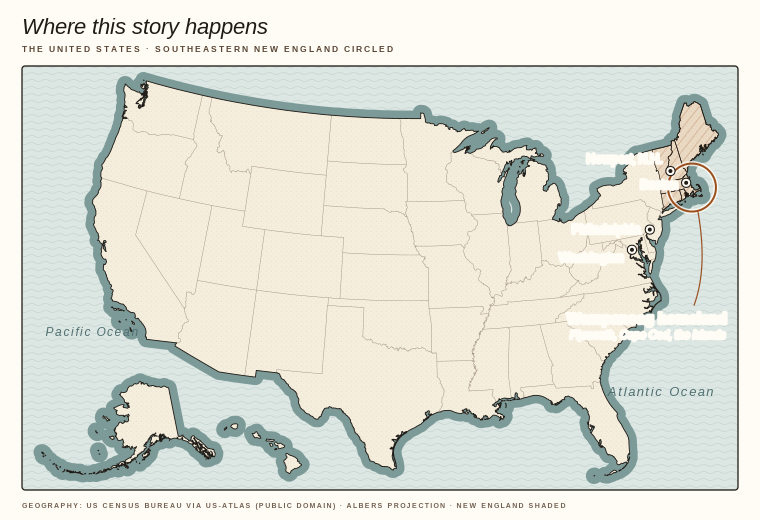
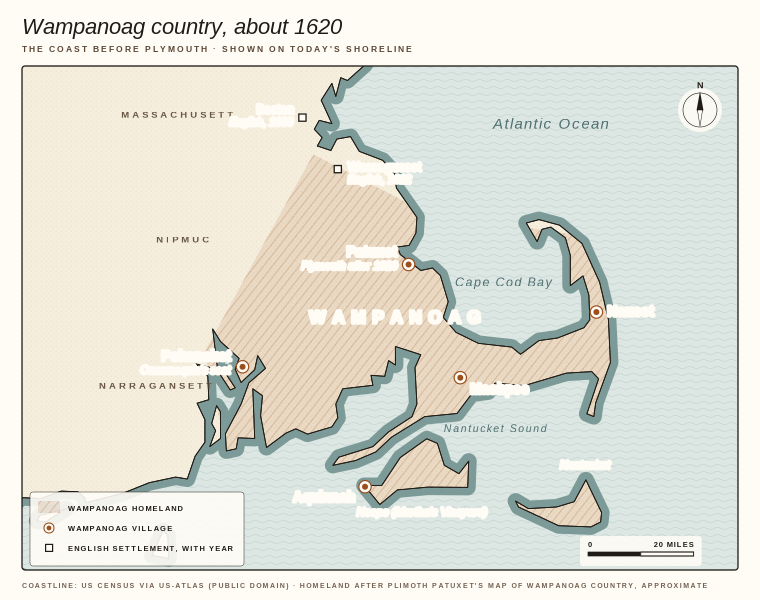
The Wampanoag get one line in the kindergarten version, usually as "the Indians," so here is the 101. They are a nation of related communities whose homeland is the coast of what's now southeastern Massachusetts and a corner of Rhode Island: Cape Cod, Martha's Vineyard (which they call Noepe), Nantucket, and the mainland from around Boston's south shore down to Narragansett Bay. Their ancestors have been there for at least 10,000 years. When Europeans first showed up, there were as many as 40,000 Wampanoag living in about 67 villages, each with its own sachem, which is the word for a leader. They farmed corn, beans and squash, fished, and moved between summer villages on the water and winter ones inland. The name probably comes from a 1614 Dutch map that labeled the region "Wapanoos." Their own word for their language is Wôpanâak.
Then, a few years before the Mayflower, something terrible happened. Between 1616 and 1619 an epidemic ran down the coast. For a long time people assumed it was smallpox; a 2010 study makes the case that it was leptospirosis, carried by rats off European ships. Whatever it was, the estimates say it killed as many as nine in ten people on the mainland. One village lost everyone. That village was Patuxet, and its cleared fields and empty houses are exactly where the Mayflower passengers landed a year later and named Plymouth. When you read that the Pilgrims found the land "empty," that is why. It had been full.
One man from Patuxet wasn't home when it happened. His name was Tisquantum; the English called him Squanto. In 1614 an English captain had kidnapped him and sold him in Spain. Friars freed him, he made it to England, and he finally got home in 1619 to find his whole village dead. He spoke English. Two years later he would be the translator between the colonists and the Wampanoag leader, and the person who showed the English how to plant corn in that soil.
What happened to them after
The alliance made in 1621 held for about fifty years, mostly on English terms. As the colonies grew they took more land and put Wampanoag people under English courts. Metacom's older brother Wamsutta had died in 1662 after the English arrested him for questioning. In 1675 Metacom, Ousamequin's son, called King Philip by the English, led a war against the colonies. That December colonial militia attacked a fortified Narragansett village in Rhode Island, and about 300 people died. Per person, it was one of the deadliest wars ever fought on this continent. Metacom was killed in August 1676, and his head was displayed at Plymouth for about twenty years. Roughly four in ten Wampanoag died, and many of the survivors were sold into slavery in Bermuda and the Caribbean. By some counts only about 400 remained on the mainland.
The communities on the islands stayed out of the war and came through more intact, which is a big part of why the two federally recognized Wampanoag tribes today are the Wampanoag Tribe of Gay Head (Aquinnah), recognized in 1987, with somewhere around 1,000 to 1,400 citizens depending on the count, and the Mashpee Wampanoag Tribe, recognized in 2007, with about 3,200.
Their language had no living speakers for over a century. It does now.
In 1993 a Mashpee woman named Jessie Little Doe Baird started the Wôpanâak Language Reclamation Project. She rebuilt the language from 1600s documents, including a Bible that had been translated into Wôpanâak in 1663, compiled a 10,000-word dictionary, won a MacArthur Fellowship for it in 2010, and raised her daughter as the first native speaker in generations. Mashpee High School has taught the language since 2018.
Next: three days in the fall of 1621
This is the part everyone thinks they know. It turns out the whole written record fits on an index card.
What we actually know about the first one
Two paragraphs, written by two men who were there. That's the entire record. Everything in every painting and school pageant was added later.
The Mayflower landed in the late fall of 1620 with 102 people on board. Before they settled, the colonists spent a month exploring Cape Cod. By their own account they dug up stored corn and took it for seed, meaning to repay the owners, and some of the party opened graves and took things from empty houses. In December they traded arrows and musket fire with a group of Native men on a beach, and both sides pulled back. By spring, about half of them were dead. In March 1621 the colony's governor, John Carver, and Ousamequin, the Wampanoag leader, made an alliance, with Tisquantum translating. That summer the corn came up.
What happened next we know from a letter. Edward Winslow, one of the colonists, wrote home on December 11, 1621, and the letter was printed in London the next year. The part about the harvest is about a hundred words long, and here is what it says. The harvest was in. The governor sent four men out to shoot birds, and they came back with enough to feed the colony for almost a week. Ousamequin showed up with about ninety men, and the colonists hosted them for three days. The Wampanoag went out and killed five deer and gave them to the governor and the captain. Winslow's point in writing was reassurance: he wanted people back in England to know the colony was, in his words, so far from want.
The only other account is William Bradford's, the governor who came after Carver. Years later, in his journal, he described the season rather than a day: plenty of cod and bass, wildfowl as winter came on, "many wild turkeys," venison, and a peck of cornmeal per person per week.
And that is all of it. No table, no date, no word "thanksgiving," nothing about who sat where. Fifty-three colonists were alive that fall: 22 men, 4 married women, and 27 kids and teenagers. The Wampanoag outnumbered them nearly two to one. Historians still debate why the Wampanoag came; the gathering may have been a diplomatic visit under the spring alliance, or the men may have come over when they heard the gunfire from the hunt. Either way, both accounts agree on the deer and the three days.
What was and wasn't on the table
| Dish | In 1621? | Why |
|---|---|---|
| Venison | Yes | Five deer, per Winslow. |
| Wild fowl, probably duck and goose | Yes | The week's worth from the hunt. |
| Turkey | Probably | Bradford mentions wild turkeys that season, not that day. |
| Corn | Yes | The harvest. Likely as meal or porridge, not on the cob. |
| Cranberry sauce | No | No sugar to sweeten them with. |
| Mashed potatoes | No | Potatoes hadn't reached New England yet. |
| Pumpkin pie | No | No wheat flour or butter for a crust. Pumpkins, yes. |
| Bread stuffing | No | Same reason. Maybe chestnuts and herbs. |
"Thanksgiving" meant something else
To the Plymouth colonists, a day of thanksgiving was a church thing: prayer, fasting, a sermon, declared for one specific blessing. The 1621 gathering was a harvest party, which is a different thing entirely. Plymouth's first real day of thanksgiving came in 1623, when rain ended a drought. Nobody connected the party to the prayer day for two centuries, which is the next part.
The fifty years after
The 1621 gathering was friendly. The years around it often were not.
In March 1623 Plymouth's military captain, Myles Standish, went to the English outpost at Wessagusset. Plymouth said it had word of a planned attack. Standish invited several Massachusett leaders to a meeting and killed them there. One man's head was carried back and set on a pole at Plymouth. The Massachusett Tribe today calls it the massacre at Wessagusset.
In 1637, during a war with the Pequot in what is now Connecticut, English forces burned a fortified Pequot village at Mystic. About 500 men, women and children died; the English commander put it higher. Massachusetts then held a day of thanksgiving in its churches for the victory. That was a prayer day, the kind described just above, and it is not where our holiday comes from. But it is a real part of what "thanksgiving" meant then.
The Massachusett and the Pequot are separate nations from the Wampanoag. The Wampanoag alliance with Plymouth lasted until 1675.
Lots of thanksgivings, no Thanksgiving
New England kept declaring thanksgiving days for two centuries. None of them had anything to do with 1621, until a historian wrote a footnote.
After 1623, thanksgiving days became a New England habit. Colonies declared them when something went right: Massachusetts Bay in 1637 after a war, the colonies together in 1676 after another one. By the 1700s an autumn thanksgiving, church in the morning and a big family dinner after, was just something New Englanders did every year. A minister in Concord described it in 1795 as a custom handed down by "pious ancestors." Notice what's missing from that: the Pilgrims. Nobody telling the story of the holiday in 1795 mentioned 1621, because nobody had connected them.
The new national government tried the idea now and then. The Continental Congress declared a thanksgiving in 1777 after the win at Saratoga and kept it up through the war. George Washington proclaimed one for November 26, 1789, and another in 1795. John Adams did two. James Madison did two in 1815, neither of them in the fall. Thomas Jefferson refused to do any; he thought religious observances were not the federal government's business. After Madison, no president touched it for almost fifty years.
Then came the footnote. In 1841 a Boston minister and historian named Alexander Young published a collection of early Plymouth documents, including Winslow's letter, and in a note under it he called the 1621 harvest "the first Thanksgiving." That's it; that's the moment. The phrase caught on. As New Englanders moved west they took their holiday with them, now with Pilgrims attached. An Iowa newspaper in 1844 welcomed "the good old Pilgrim holiday." And the picture in your head, the long outdoor table with everyone in buckles, comes from an 1889 novel called Standish of Standish and the illustrations it inspired.
National thanksgivings before there was a national holiday
Next: the woman who wouldn't let it go
By the 1840s New England had a holiday and the country had a phrase. What it didn't have was a date. That took one person and seventeen years.
Sarah Josepha Hale
A widow with five children became the most read editor in America, wrote "Mary Had a Little Lamb," and spent seventeen years asking for one national holiday. Four presidents ignored her.
Nobody mentioned her in kindergarten, and she is the reason the holiday exists.
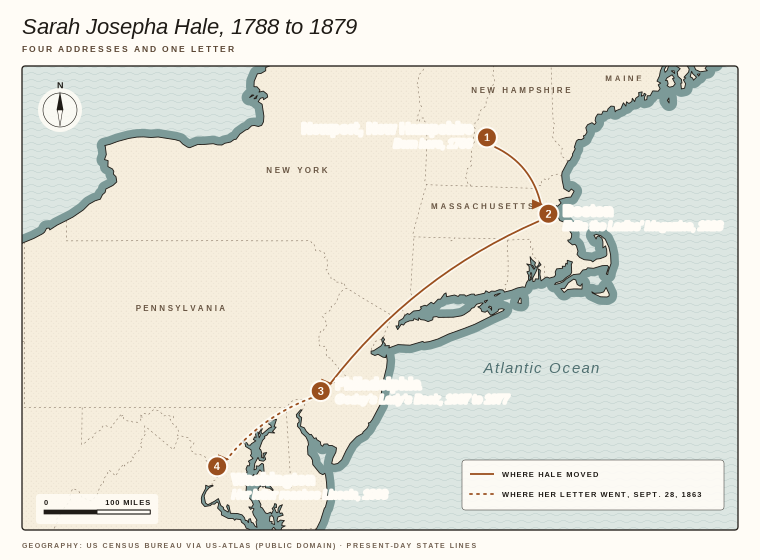
Sarah Josepha Buell was born in 1788 in Newport, New Hampshire, and taught herself out of her brother's Dartmouth textbooks because girls weren't sent to college. She married a lawyer named David Hale in 1813. In October 1822 he died of pneumonia and left her, at 34, with four children and a fifth on the way. She put on black mourning clothes and wore them for the rest of her life, which turned out to be 57 more years. She also started writing, because she had five kids to feed.
Her 1827 novel Northwood has a whole chapter about a New England Thanksgiving dinner, roast turkey at the head of the table, and it's one of the first printed descriptions of one anywhere. The book got her a job editing a new magazine for women in Boston. She took it in 1828, which meant leaving four of her children with relatives. In 1837 she became editor of Godey's Lady's Book in Philadelphia and ran it for forty years. By 1860 it had 150,000 subscribers, more than any magazine in the country. For a generation of American women, she decided what they read, what they wore, and what they cooked.
She used that. She raised the money to finish the Bunker Hill Monument. She helped the campaign that saved George Washington's house at Mount Vernon. She pushed for women's colleges and backed the founding of Vassar. And starting in 1846 she asked, every single year, in editorials and in letters to governors and presidents, for one national Thanksgiving on the same day everywhere. Her argument was that a country that was starting to come apart needed one day a year when everyone sat down at the same time. Zachary Taylor, Millard Fillmore, Franklin Pierce and James Buchanan all ignored her.
On September 28, 1863, three months after Gettysburg, she wrote to Abraham Lincoln, and separately to his Secretary of State, William Seward. Five days later, on October 3, Lincoln issued a proclamation, drafted by Seward, asking Americans to observe the last Thursday of November as a day of thanksgiving. It was the date she had suggested. She was 75 years old. She kept editing the magazine until she was 89, and died in 1879.
Next: two presidents
Lincoln's proclamation made the holiday national. It did not make it law, and that turned out to matter seventy-six years later.
Set in 1863, moved in 1939, fixed in 1941
Lincoln made it national in the middle of a war. Roosevelt tried to move it for the sake of Christmas shopping, and half the country refused.
Lincoln's October 1863 proclamation was one of nine thanksgiving proclamations he issued during the war, so what was different about this one? It didn't name a particular victory, and it asked for a day that would come back every year. Every president after him repeated it, and from 1864 to 1939 Thanksgiving fell on the last Thursday of November. One more wrinkle: the Confederacy had declared its own thanksgivings in 1861 and 1862. The holiday meant to hold the country together started out as two.
Now skip ahead to 1939. The last Thursday of November that year was the 30th, which left only 24 shopping days before Christmas, and the country was still in the Depression. Fred Lazarus Jr., who ran Federated Department Stores, lobbied the White House, and in August Franklin Roosevelt announced he was moving Thanksgiving up a week, to November 23. He could do that, because Thanksgiving was still just a presidential proclamation, not a law.
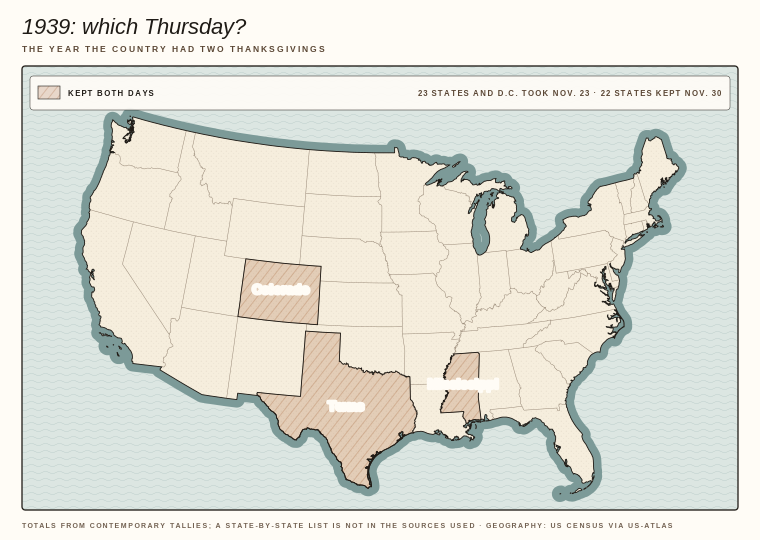
People were furious. The mayor of Atlantic City called it "Franksgiving," and the name stuck. A Gallup poll found 62 percent of the country against it. And because it was only a proclamation, every state got to choose. Twenty-three states and Washington, D.C. took the new date. Twenty-two kept the old one. Colorado, Mississippi and Texas gave up and took both. Families split across a state line ate on different days; college football schedules broke. Roosevelt did it again in 1940 and 1941, and then the Commerce Department reported that moving the holiday hadn't changed retail sales at all.
On December 26, 1941, nineteen days after Pearl Harbor, Roosevelt signed a joint resolution of Congress that finally made Thanksgiving a law: the fourth Thursday in November, which is the same as the last Thursday most years and a week earlier in the years it isn't. Texas kept the old date until 1956.
Next: the table
The date was settled. The menu wasn't. Most of what's on a Thanksgiving table showed up in the century after Hale, and some of it came from a marketing department.
When each tradition showed up
Almost nothing on a Thanksgiving table was there in 1621. Here's when each thing arrived.
The turkey was there first, mostly because it made sense. A turkey is big enough to feed a family, it was cheap, and unlike a cow or a hen it wasn't needed for anything else. Hale's 1827 novel put it at the head of the table and it never left. The rest of the menu arrived one dish at a time, and the dates say a lot about who was selling what.
Next: back to Plymouth
That's the table most of the country sits at. The story has one more part, and it happens on a hill overlooking the harbor where it started.
The National Day of Mourning
Since 1970, on the same Thursday, Wampanoag and other Native people have gathered on Cole's Hill in Plymouth. It started with a speech that wasn't allowed to be given.
In 1970 Massachusetts marked 350 years since the Mayflower landed with a big celebratory dinner, and the organizers invited a Wampanoag man named Frank James, whose Wampanoag name was Wamsutta, to give a speech. They asked to see it first. The speech talked about the epidemic, the land that was taken, the Wampanoag people sold into slavery after King Philip's War, and what it felt like to be asked to celebrate the Pilgrims' arrival. The organizers told him he couldn't give it as written and handed him a different speech, written by their public relations people. He said no.
So on Thanksgiving Day, November 26, 1970, he gave his own speech anyway, outdoors, on Cole's Hill, next to the statue of Ousamequin that looks out over Plymouth harbor, to about 500 Native people who had come to hear it. They called the day a National Day of Mourning. The group he founded, United American Indians of New England, has held it every year since, at noon on the fourth Thursday of November, on the same hill.
In the organizers' own words, the day is meant to teach people about the Wampanoag and other Eastern tribes, to correct the myths of the Thanksgiving story, and to call attention to things Native people are dealing with now. It is also a day for remembering ancestors. In 1997 police arrested 25 marchers; the town of Plymouth settled with the organizers the next year and dropped the charges. Many Wampanoag families also sit down to a meal that day. The two aren't opposites. And since 1990, November has been Native American Heritage Month.
Where this leaves us
The holiday is younger than we were taught. It was built by a lot of people with different reasons, over a long time, and the people it started with are still here, on the same coast, speaking a language they brought back. Whichever table you're at on Thursday, now you know the whole story.
On one page
Everything above, in order. Read this before the quiz, or instead of the rest if you're short on time.
The quiz
Twelve questions, one or two per section. Wrong answers explain the right one.
Where this comes from
Every claim in this guide traces to one of these. If something is wrong, write to me and I'll fix it and note the correction here.
None yet. First published November 2026.
Primary and museum sources
Secondary sources
Where sources disagree
Pre-contact Wampanoag population ranges from a few thousand to 40,000 depending on who's counting and what area. Hale's campaign is given as 17 years (the letters) or 36 (the essays). The 1939 state-by-state choices are given as totals, not a list, in the sources used here, so Map 4 marks only the three states every source names. The 1917 marshmallow booklet is credited to Angelus Marshmallows by some and to Cracker Jack by others; the same company owned both.